Contained Ascent
He did not send us a living room.
He did not send a sofa, a dining table, or a neatly arranged corner.
He sent a staircase.
A spiral of wood and steel rising through shadow and light.
At first glance, it looked like a structural element. A beautiful one, yes, but still only a staircase. Yet when we listened to his story, the image became something else entirely.
When he speaks of home, he says family.
When he speaks of home again, he says it is still forming.
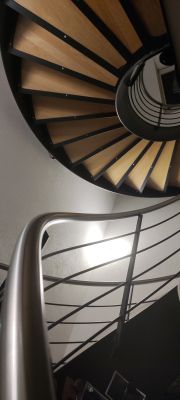
Belonging and becoming
He returns at the end of the day needing quiet. He needs to feel held, not stimulated. He prefers clear routines. He feels most himself in the morning, after meditation. He thinks best while walking. He values harmony, clarity, and warmth in shared spaces. He relates to wood, metal, glass. He needs a garden, plants, changing weather. He is comfortable with waiting.
And suddenly the spiral made sense.
The staircase was not a transition between floors. It was a portrait.
The upward movement reflected his inner ascent. The circular motion echoed his thinking rhythm. The exposed materials spoke of his preference for honesty and clarity. Yet something was missing. The structure was present, but the containment was not. The movement was visible, but the grounding was not articulated.
So we did not redesign the staircase.
We listened to it.
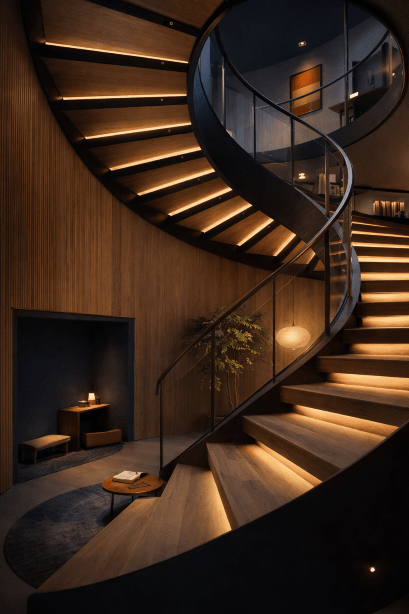
We softened the light beneath each tread so ascent would glow rather than glare. We introduced vertical timber to quiet the echo and warm the atmosphere. We created a circular grounding space at the base, transforming circulation into the centre. Not a corridor, but a place to pause.
Beneath the spiral, a small meditation niche emerged. A muted blue backdrop, a simple wooden bench, filtered light. A place for morning alignment before the day unfolds upward. The architecture now holds the ritual.
Plants rise along the curve, connecting interior movement to organic growth. A controlled orange artwork introduces warmth. Subtle red accents carry energy without overwhelming. Glass preserves openness, while wood absorbs sound and anchors the senses.
The staircase becomes more than structure.
It becomes a lived metaphor.
Contained, yet open.
Grounded, yet ascending.
Formed, yet still forming.
In shared space, he does not seek territory. He seeks a shared centre. The spiral now gathers rather than divides. It invites slow walking, quiet reflection, and gentle convergence.
This project reminded us that sometimes the most powerful room in a house is not a room at all. It is the movement between them. It is the rhythm. It is the quiet ascent.
The home was not redesigned.
It was aligned.
And in that alignment, the staircase began to feel less like steel and timber, and more like belonging in motion.
 Narrative Dwelling Design