In Quiet Equilibrium
Some homes seek attention.
Others seek harmony.
This project began with a different aspiration: to create a home capable of holding the delicate balance between seemingly opposing aspects of life.
Through the Narrative Dwelling Design process, we discovered that the person at the centre of this project did not desire a home defined by trends, luxury, or visual statements. Instead, she sought a place that could support a life lived thoughtfully between activity and rest, solitude and connection, quiet and engagement.
For her, home was first experienced as refuge, a place of peace, familiarity, and gentle control. Yet it was equally important that the home remained alive; responsive to changing light, daily rhythms, meaningful objects, and the presence of those she cared about.
The challenge was not a lack of functionality. The home already accommodated everyday life. The deeper question was whether the spaces truly reflected the way life was experienced within them.
Our phenomenological exploration revealed a recurring theme: “balance”.

Not balance as symmetry or perfection, but balance as an ongoing practice. A home that neither withdraws entirely from the world nor becomes overwhelmed by it. A home that allows one to be present without exposure, connected without intrusion, and reflective without isolation.
The design response emerged from this understanding.
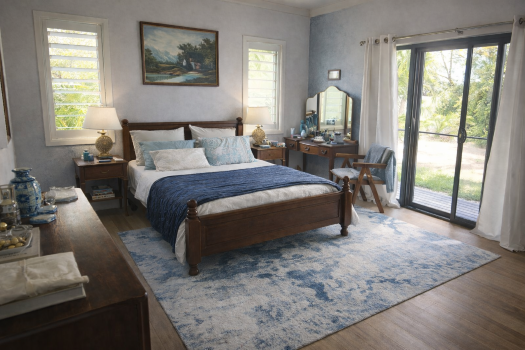
Natural materials such as timber and stone became the foundation of the project, chosen for their ability to carry memory through time.
A restrained palette of whites, soft blues, and muted natural tones established a calm visual field, while carefully selected objects and textiles introduced moments of personal expression.
Visual clutter was reduced, not to achieve minimalism, but to create coherence. Storage was reconsidered as a tool for clarity. Rooms were organised around gentle transitions rather than abrupt separations, allowing movement through the home to feel intuitive and calm.
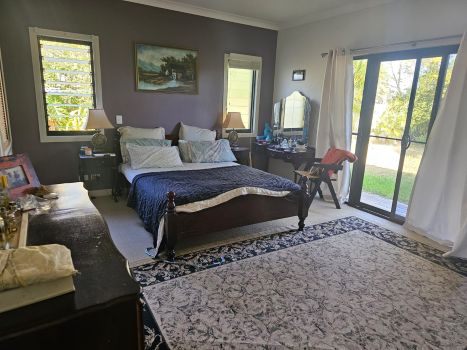
In the bedroom, the emphasis was on restoration. Familiar materials, softened light, and a carefully composed atmosphere transformed the room into a place of retreat while maintaining a subtle connection to the changing world beyond.
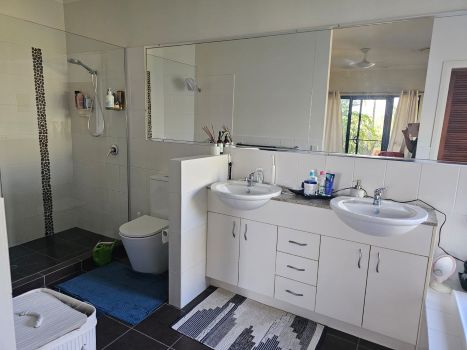
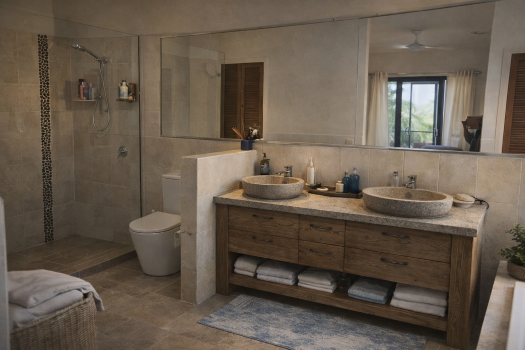
The ensuite bathroom was reimagined as a sequence of experiences rather than a purely functional space. Layered zones, natural textures, and controlled lighting created opportunities for quiet reflection within everyday rituals.
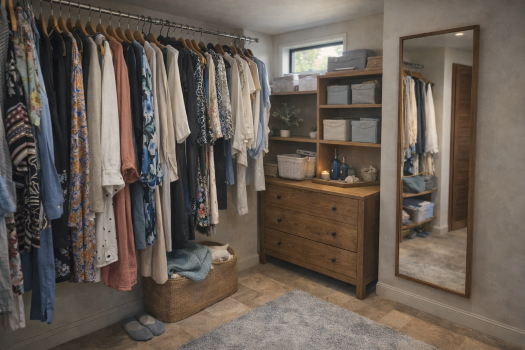
The walk-in wardrobe evolved from a place of storage into a place of orientation. Visibility became intentional. Selection became simpler. The space no longer demanded attention but instead supported clarity and ease.
Together, these interventions transformed the home into something more than a collection of renovated rooms.
It became a dwelling capable of supporting a particular way of being.
A place where peace does not require withdrawal.
A place where memory is carried through materials.
A place where everyday life can unfold in balance.
In quiet equilibrium.
 Narrative Dwelling Design