
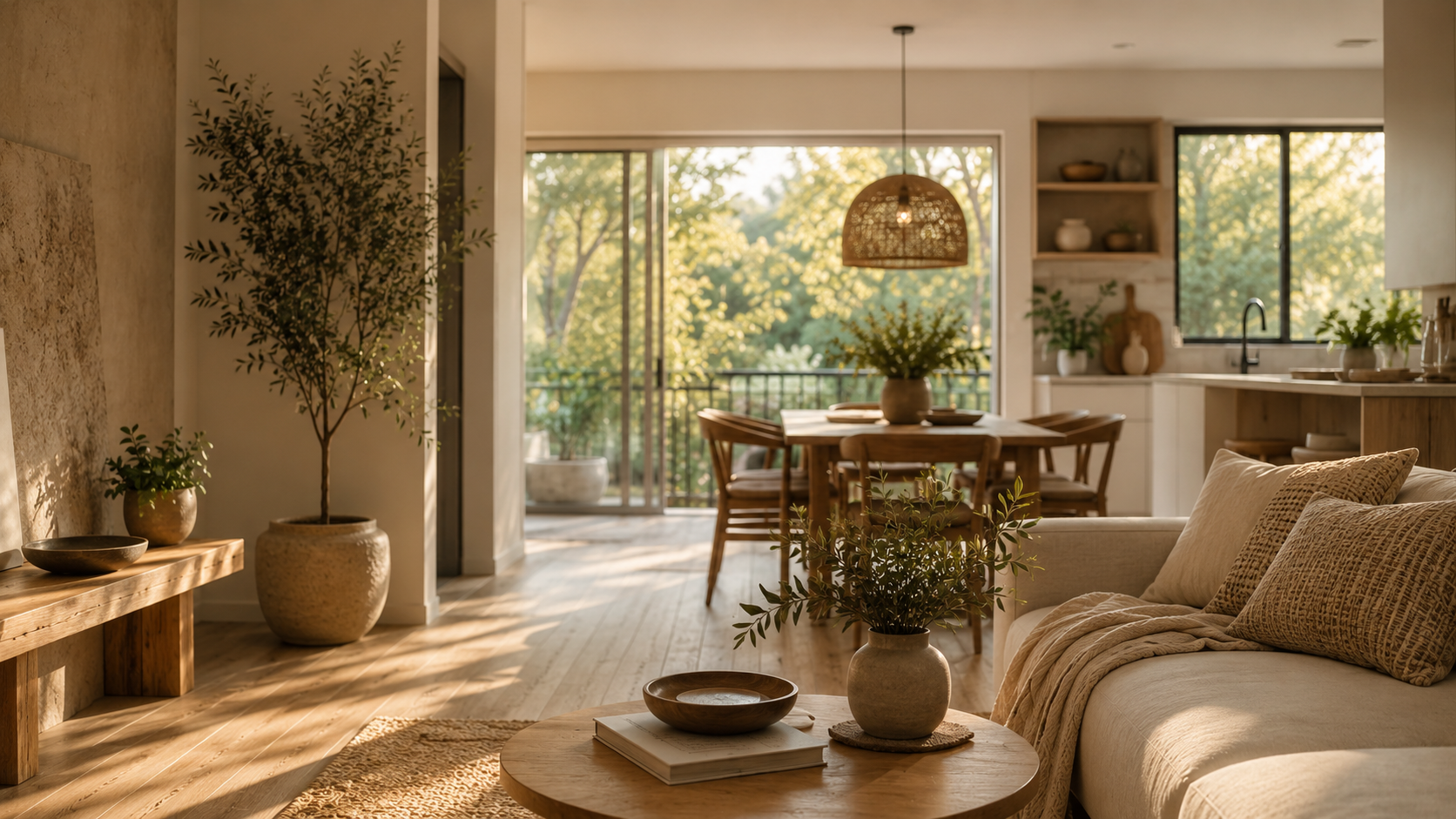

Why Renovating a
“House” Does Not Always Create a “Home”?
A few weeks ago, I sat with a client during what was intended to be an ordinary design discussion. She had a clear vision of what she wanted to renovate. There were plans for a larger kitchen with a pantry, better storage, more natural light, and finishes that felt contemporary and timeless.
As we continued talking, the conversation shifted. She spoke about how the family rarely spent time together anymore. She missed the spontaneous conversations that once happened around the kitchen table. She wanted a home where her children and their friends would enjoy visiting, where she could feel calm after demanding days, and where everyday life felt less rushed and more connected.
He spent a fortune renovating her kitchen, but after three years, there were still no splash backs because she was unsure about the outcome. At one point, she paused and said something that stayed with me: “I want to feel at home here.”

That sentence captured something I have observed repeatedly throughout my professional life.
People rarely renovate because they need new tiles, cabinetry, luxury, or paint colours.
They renovate because something deeper feels missing.
Sometimes it is a connection. Sometimes it is belonging. Sometimes it is comfort, identity, or the desire to create new memories. Yet, despite substantial investments of time and money, many homeowners eventually discover that their beautifully renovated house still does not feel like home.
This is not necessarily a design failure. Often, it is a human failure in the design process itself.
The Missing Question
──
Traditional renovation processes usually begin with practical questions:
- What is your budget?
- How many bedrooms do you need?
- Which materials do you prefer?
- What style do you like?
These questions are important. However, they often overlook a more fundamental one:
How do you want to live, feel, and experience your everyday life in this place?
Research in environmental psychology, phenomenology, and socially responsible design increasingly demonstrates that our environments influence our emotions, relationships, behaviours, and sense of self. Spaces are not neutral containers. They actively shape our lived experiences.
Yet many interior designers ask clients to make decisions about finishes and layouts before they understand the experiences they are actually seeking in their future home.
As a result, projects often produce houses that are functional and visually appealing but lack emotional connection and a genuine sense of belonging.
The Narrative Dwelling Design Difference
──
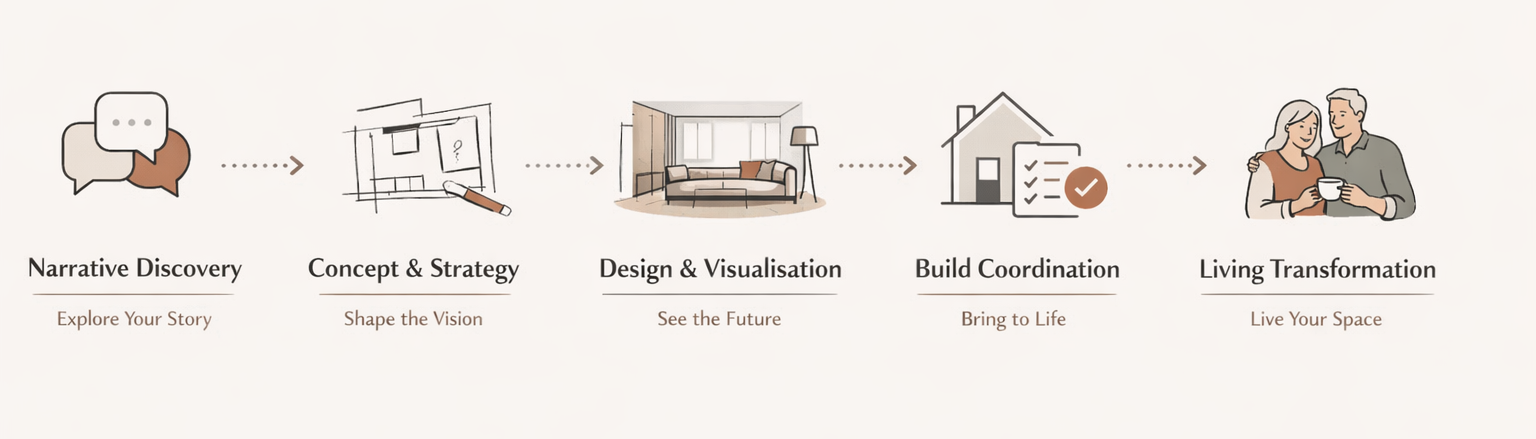
Narrative Dwelling Design (NDD) was created to address this gap. Our approach is informed by phenomenological research and human-centred design principles. Rather than beginning with rooms and materials, we begin with people and their stories.
We seek to understand:
- How do you currently experience your home?
- Which spaces hold meaningful memories?
- What routines and relationships matter most to you?
- How do you want your future home to support your wellbeing, identity, and aspirations?
Through structured conversations and phenomenological interviews, we uncover the lived experiences that often remain unspoken during conventional design processes.
This process allows us to translate human experiences into spatial intentions.
A kitchen becomes more than cabinetry and appliances; it becomes a place for family rituals and connection.
A living room becomes more than furniture placement; it becomes a setting for comfort, belonging, and shared memories.
A study becomes more than a functional workspace; it becomes an environment that supports focus, creativity, and personal growth.

Designing With You, Not Merely For You
──
Contemporary social innovation research suggests that meaningful design emerges when people become active participants in shaping solutions rather than passive recipients of professional expertise.
At Narrative Dwelling Design, we embrace this principle.
We do not begin by asking what style is currently fashionable.
We begin by listening.
Every household has its own stories, relationships, routines, values, and aspirations. Every dwelling therefore deserves a response that is equally unique.
Our role is not simply to design spaces.
Our role is to help people articulate experiences that are often difficult to express and transform them into meaningful environments.
We do not simply design spaces. We help people translate their lived experiences into places that feel like home.
Narrative Dwelling Design
From House Renovation to Home Creation
──
A successful renovation should achieve more than improved functionality or increased property value.
It should create spaces that nurture relationships, support wellbeing, reinforce identity, and foster a genuine sense of home.
Because people do not simply live inside buildings.
They dwell within experiences, memories, relationships, and stories.
At Narrative Dwelling Design, we believe the purpose of design is not merely to renovate a house.
It is to help people create places that truly feel like home.
Reference
──
Ndovela, X., Olalere, F. E., & Reynolds, M. C. (2022). Design for Social Innovation: A Value Creation for Intensifying Interior Design’s Social Compact. International Journal of Design Management and Professional Practice, 16(2), 53–75. https://doi.org/10.18848/2325-162X/CGP/v16i02/53-75
ON THIS PAGE
──
TOC
Share This Article
──
The Latest Journals
──


Tell Us Your Story
──

Reader Appreciation
──
Leave a Reply